

Mature Skin · Guide
You moisturize, you wear sunscreen, and still your pores look bigger in the mirror than they did ten years ago. Here is what menopause and time do to the skin around a pore, and the routine that makes them look smaller again.

The short answer
Pores look bigger after menopause mostly because the skin around them loses firmness. With less collagen and elastic support, round openings stretch into ovals and the surface casts more shadow.123 Sun damage adds to it, and a rough, dry surface makes it worse. You can’t change the pore itself, but you can make it look smaller: a retinoid at night, gentle twice-daily cleansing, a moisturizer, daily SPF 30+, and no scrubbing or squeezing.1
01Why do pores look bigger after menopause?
Most of us learned about pores as teenagers, when big pores meant oily skin and breakouts. So it is confusing when they seem to grow just as your skin turns drier. In fact, after menopause the main driver usually isn’t oil. It is support.
A pore is the opening of a hair follicle and its oil gland. The skin around it is held in shape by collagen and elastic fibers. When estrogen falls, skin loses about 30% of its collagen in the first five years after menopause,1 and the American Academy of Dermatology (AAD) notes that as skin loses firmness and sags, pores look larger.2
of peri- and postmenopausal women aged 45 to 60 reported a loss of facial firmness and elasticity in a nine-country survey of more than 4,300 women, presented in 2026.4
Firmness is exactly what holds pores closed and round, which is why so many women notice the two changes together. It is also why the same pore that barely showed at 35 can look like a tiny dent at 55.
02What changes around a pore after 50?
Three things tend to happen at once. Each one is small, but together they change how light falls on the skin around every pore.
1. Less firmness, so pores stretch
In a study of 60 adults, skin with lower elasticity had more visible pores.5 Another study measured the cheeks of 116 women aged 20 to 60 and found that pores slowly change shape with age, from round to long ovals, with the biggest jumps between the 30s and 40s and again between the 50s and 60s.6 An oval, drooping opening catches more shadow than a round one, so it reads as bigger.
2. Less oil, but bigger glands
Here is the surprise. In women, sebum output decreases gradually after menopause, yet the oil glands themselves become larger, not smaller, because their cells turn over more slowly.7 So your skin can feel drier while the openings stay wide. That is why oil-control products made for teenage skin often do little for pores after 50, and can leave mature skin tight and irritated.
3. A rough surface and old plugs
Dry, slow-shedding skin leaves more dead cells on the surface. When they collect at the rim of a pore, along with old sebum, the opening looks darker and more defined. The AAD notes that clogged pores make pores look larger.2

Where you see it most
Pores usually show most on the nose and forehead. In a study of 434 facial images, enlarged pores were more prominent on the nose and forehead than on the cheeks, and the number of enlarged pores rose with age, with a clear step up between the 30s and 40s.8
The same study found that pore counts tracked with wrinkle severity, which fits the idea that pores and lines share a cause: skin that has lost some of its structure.
03Is it menopause, age or sun damage?
Usually all three, and they are hard to separate. Hormones clearly affect pores: in a study of 60 volunteers, pore size was linked to sebum output, sex and age, and in women pores were measurably larger during the ovulation phase of the cycle.9 After menopause the hormonal pattern changes again, and the loss of collagen speeds up.1
Sun is the other big factor. The AAD says sun damage reduces skin firmness, which makes pores more visible.2 Decades of UV exposure tend to show up in the late 40s and 50s, right when menopause arrives. Many women blame these changes on age alone: in a survey of more than 5,000 women released by Galderma this October, 56% said they first put their menopause-related skin changes down to aging.10
The practical point is the same either way. You can’t stop time, but you can protect collagen from UV, support the surface, and keep the rim of each pore clear.
04Can you actually shrink your pores?
“You can shrink your pores for good.”
Pore size is shaped by genetics, ethnicity, sex and sun exposure, and a large study of 2,585 women found that pore size and density mostly plateau with age rather than climbing forever.1113 No cream closes a pore. What you can change is how visible it is: firmer, smoother, clearer skin around the opening makes it look smaller.2
“Big pores always mean oily skin.”
Oil matters in younger skin, but sebum falls after menopause while the glands get larger.7 In mature skin, loss of firmness and sun damage are often the bigger story.25 Stripping oil away won’t fix that, and can leave skin dry and rough.
“Scrubbing and squeezing keep pores clean.”
The AAD advises never to scrub, rub, pick at or squeeze the skin on your face, because the irritation makes pores look larger.2 Pore strips and gritty scrubs are a short-term fix with a long-term cost on thin, mature skin.
05Which ingredients make pores look smaller?
Retinoids: the best-studied option
The AAD suggests considering retinol if your skin is less firm and your pores look enlarged, applied at bedtime.2 Retinoids encourage cell turnover and support collagen, which helps both the surface and the structure around a pore. Retinal (retinaldehyde) works one step closer to retinoic acid than retinol, and is a good fit for mature skin that wants results without prescription-level irritation.
In an 8-week study of 32 women using a 0.1% retinal serum three nights a week, the appearance of pores improved by 20%, the most of any measure, with no signs of irritation on patch testing.12 That was a different formula from ours, and results vary, but it shows what a well-buffered retinal can do for pores in two months.

Our pick for visible pores
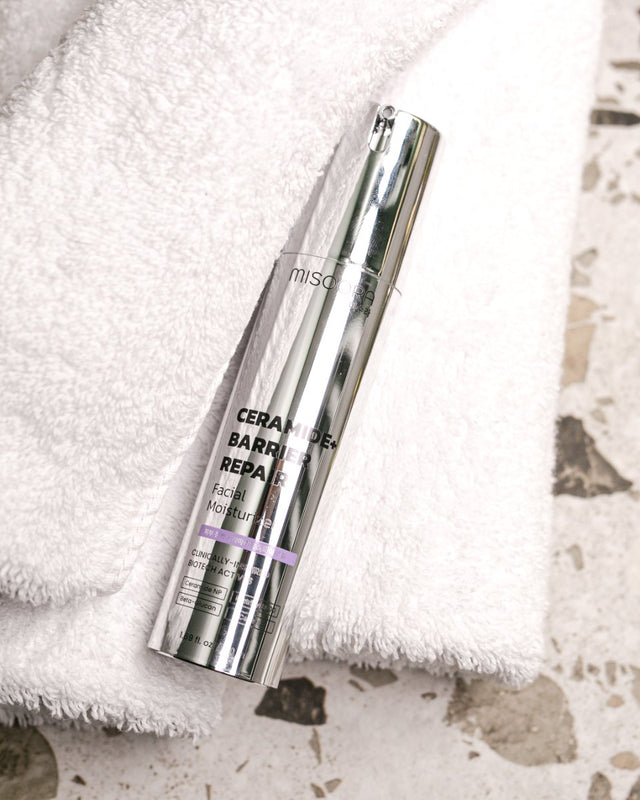
Retinal 0.2% Barrier Serum
Retinaldehyde at 0.2% in a barrier-supporting base, made for mature, sensitive skin. Use it at night to help pores, fine lines and rough texture look smoother and more refined.
Shop Retinal 0.2%Salicylic acid: only if pores are clogged
If you still get blackheads or the odd breakout, a salicylic acid cleanser can help unclog pores. If it dries your skin, the AAD suggests alternating it with a mild cleanser.2 If your skin is dry and pores are simply stretched, you probably don’t need it.
Firming serums: support the skin around the pore
Because loss of firmness drives so much of what you see, a morning serum aimed at firmer-looking skin is a sensible partner to a night retinoid. It won’t rebuild collagen on its own, but it keeps the routine focused on structure rather than oil control.

Our pick for firmer-looking skin
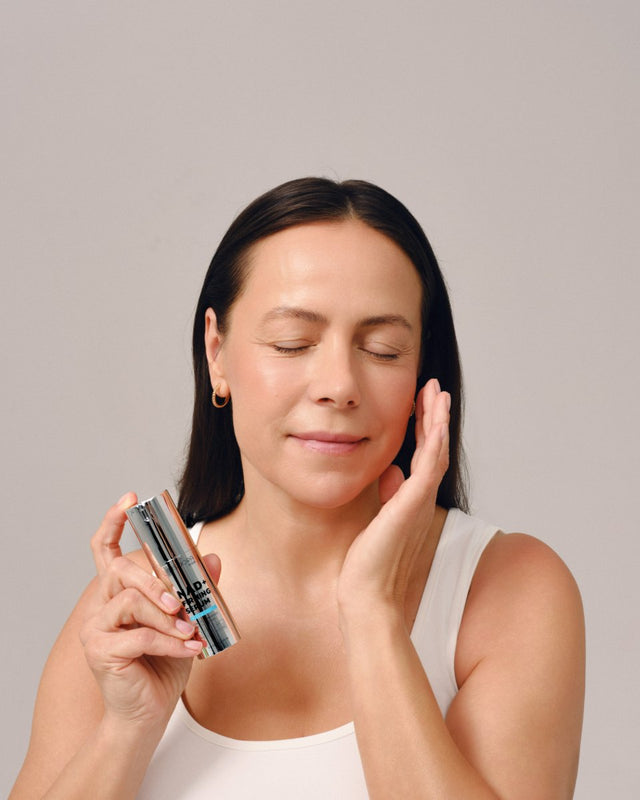
NAD+ Firming Serum
2,500 ppm NAD+ with peptides for visibly firmer, smoother-looking skin. Light enough to wear under SPF and makeup every morning.
Shop NAD+ SerumSunscreen: the step that protects everything else
The AAD recommends a broad-spectrum, water-resistant sunscreen with SPF 30 or higher every day, even on cloudy or cold days, because sun damage reduces firmness and makes pores more visible.2 Look for products labeled non-comedogenic, oil-free or won’t clog pores.2
06How should you cleanse skin with large pores?
Gently, twice a day. The AAD recommends washing with warm, not hot, water and a gentle, non-comedogenic cleanser, without scrubbing.2 Use your fingertips, rinse well, and pat dry. That clears the day’s sunscreen, makeup and oil from the rim of each pore without roughing up the surface around it.
Light layers, not heavy ones
Mature skin still needs moisture, but it does best with layers that sink in: a fluid serum, then a moisturizer, rather than one thick, greasy layer. A smooth, hydrated surface reflects light evenly, which helps pores look less obvious.
When you try something new, patch it on a small area first, and introduce one product at a time so you can tell what your skin likes.


Our pick for gentle cleansing
Centella Ceramide Amino Acid Cleanser
A sulfate-free, pH-balanced cleanser with centella and ceramides that lifts away SPF and makeup without the tight, squeaky feeling that makes mature skin look rough.
Shop the cleanser07A routine for visible pores after 50
Keep it short and consistent. Pores respond to steady care over weeks, not to one dramatic treatment.
Morning
Cleanse, firm, protect

Evening
Renew and recover

The evening order matters: retinal first, then the PDRN serum, then moisturizer. Our PDRN Exosome EGF Serum pairs 2,000 ppm PDRN with exosomes, EGF and a peptide (2,100 ppm of actives in total) to help skin look smoother, denser and more even. If you are new to retinoids, start with a few nights a week and build up as your skin allows. Give it 8 to 12 weeks before you judge your pores.


08When to see a dermatologist
If you want faster or bigger changes, a dermatologist can help. A review of 19 clinical trials covering 591 patients found that lasers and other in-office treatments reduced pore size and number, that several sessions and combined treatments worked best, and that mild, temporary redness and burning were the most common side effects.13 The AAD also notes that many firming procedures need no downtime.2
See a doctor sooner if a single pore suddenly looks different from the rest, if a bump keeps bleeding or doesn’t heal, or if new breakouts appear alongside other changes. Those are worth checking rather than treating at home.
Key takeaways
- After menopause, pores usually look bigger because skin loses firmness, not because of extra oil.
- Skin loses about 30% of its collagen in the first five years after menopause, and pores slowly stretch from round to oval.
- Sebum drops after menopause, but oil glands get larger, so dry skin can still have visible pores.
- No product closes a pore. A retinoid at night, gentle cleansing, a moisturizer and daily SPF 30+ make pores look smaller.
- Skip scrubs, pore strips and squeezing. Irritation makes pores look larger.
FAQ
Why are my pores getting bigger in my 50s?
Mostly because the skin around them is losing collagen and elasticity, so the openings stretch and sag. Years of sun exposure and a rougher, drier surface add to the effect.
Can menopause cause large pores?
Indirectly, yes. Falling estrogen speeds up collagen loss, and less firm skin makes pores more visible. Menopause also lowers oil output, so pores in mature skin are less about oil and more about structure.
Does retinol or retinal shrink pores?
Retinoids can make pores look smaller by smoothing the surface and supporting collagen, but they do not change the pore itself. Expect gradual change over 8 to 12 weeks of regular use.
Do pore strips work on mature skin?
They can lift out surface plugs, but they don’t change pore size, and pulling and scrubbing can irritate thin skin. The AAD advises against squeezing and rough handling.
Is it OK to use a moisturizer if my pores look big?
Yes. Dry, rough skin makes pores look more obvious. Choose a moisturizer labeled non-comedogenic or won’t clog pores, and apply a thin layer.
Keep reading
- Why Skin Sags After Menopause, and What Creams Can (and Can’t) Do
- Retinal vs Retinol vs Tretinoin After 50: Which Retinoid Suits Mature, Sensitive Skin
References
- American Academy of Dermatology. Skin care during menopause. aad.org
- American Academy of Dermatology. What can treat large facial pores? aad.org
- Thornton MJ. Estrogens and aging skin. Dermatoendocrinol. 2013;5(2):264-270. PubMed 24194966
- Galderma survey of 4,300+ peri- and postmenopausal women aged 45 to 60 in nine countries, presented at IMCAS World Congress 2026. Reported in: Survey reveals knowledge gap in menopause-related skin changes. Plastic Surgery Practice, February 2026. plasticsurgerypractice.com
- Kim BY, Choi JW, Park KC, et al. Sebum, acne, skin elasticity, and gender difference: which is the major influencing factor for facial pores? Skin Res Technol. 2013;19(1):e45-e53. PubMed 22211382
- Jang SI, Kim EJ, Lee HK. A method of evaluating facial pores using optical 2D images and analysis of age-dependent changes in facial pores (…). Skin Res Technol. 2018;24(2):304-308. PubMed 29383766
- Pochi PE, Strauss JS, Downing DT. Age-related changes in sebaceous gland activity. J Invest Dermatol. 1979;73(1):108-111. PubMed 448169
- Jung HJ, Ahn JY, Lee JI, et al. Analysis of the number of enlarged pores according to site, age, and sex. Skin Res Technol. 2018;24(3):367-370. PubMed 29393550
- Roh M, Han M, Kim D, et al. Sebum output as a factor contributing to the size of facial pores. Br J Dermatol. 2006;155(5):890-894. PubMed 17034515
- Galderma. New Galderma research reveals more than half of women mistake menopause-related skin changes for signs of ageing. Business Wire, October 13, 2026 (survey of 5,090 women in the US, UK, Brazil and China; data on file). uniindia.com
- Flament F, Francois G, Qiu H, et al. Facial skin pores: a multiethnic study. Clin Cosmet Investig Dermatol. 2015;8:85-93. PubMed 25733918
- Konisky H, Bowe WP, Yang P, et al. The clinical efficacy and tolerability of a novel retinaldehyde serum with firming peptides to improve skin texture and signs of photoaging. J Drugs Dermatol. 2024;23(11):992-997. PubMed 39496127
- Parvar SY, Amani M, Shafiei M, et al. The efficacy and adverse effects of treatment options for facial pores: a review article. J Cosmet Dermatol. 2023;22(3):763-775. PubMed 36440737
Written by MISOORA Editorial. This article is for general information and is not medical advice. Skincare results described are cosmetic and vary from person to person. If you have concerns about changes in your skin, talk to your doctor or a board-certified dermatologist.