

Menopause & Mature Skin · Guide
You bought the serum, used it for two weeks, and the mirror looks the same. Before you give up on it, here is how long skincare really takes to work after menopause, what you should notice first, and when it is fair to judge.

The short answer
Most skincare products take at least six weeks to show results, and some take up to three months, according to the American Academy of Dermatology.2 After menopause, plan on the longer end. The skin surface renews more slowly with age,3 so changes in texture and tone take longer to show. A good moisturizer can make skin feel better within hours.6 Retinoids need months: in clinical studies, wrinkle changes were measured at 18 to 24 weeks.89
01How long does skincare take to work?
Longer than most of us would like. The American Academy of Dermatology says most products take at least six weeks to work, and sometimes up to three months.2 That is the general rule for adult skin. For women past menopause, the clock tends to run slower, for reasons we cover below.
Different products also work on different timelines. Moisture is fast. Texture and glow take a few weeks. Lines and firmness take months. Knowing which is which keeps you from tossing a good product too early, or keeping a bad one too long.
of women first put their menopause-related skin changes down to ordinary aging, in a 2026 survey of 5,090 women in the US, UK, Brazil and China. Seven in ten had bought aging-focused products for those changes.1
That matters for timing. If you treat menopausal dryness and thinning like regular wrinkles, you may wait months for the wrong product to work. The same survey found that 62% of women felt overwhelmed by skincare advice during perimenopause or menopause.1 A clear timeline helps cut through that.
02Why does skin take longer to respond after menopause?
Three changes slow things down.
- Your skin surface renews more slowlyIn a classic study, the outer layer of skin took about 20 days to renew in young adults. In older adults it took more than 10 days longer.3 Anything that works by bringing fresher cells to the surface needs more time to show.
- There is less collagen to work withSkin can lose about 30% of its collagen in the first five years after menopause.4 Products that help skin look firmer are working against a steeper slope.
- Barrier repair is slowerWhen researchers disrupted the skin barrier, it had recovered about 50% after 24 hours in people aged 20 to 30, and only about 15% in people over 80.5 Irritation from a strong product can take longer to settle, which is another reason to go slowly.
For more on why menopausal skin looks flat and gray as renewal slows, see our guide to dull skin after menopause.
03What should I notice in the first two weeks?
Comfort. Moisturizers are the fastest-acting step you have. In a randomized study, a single application of a ceramide cream raised skin hydration within two hours, and the boost was still measurable 24 hours later.6 Skin that is well hydrated looks smoother and less tight, which is why many women notice a difference in how their face feels before they notice anything else.
To get the most from it, the AAD suggests applying moisturizer to slightly damp skin, and choosing a cream if you are perimenopausal or over 50.12

Our pick for the first weeks
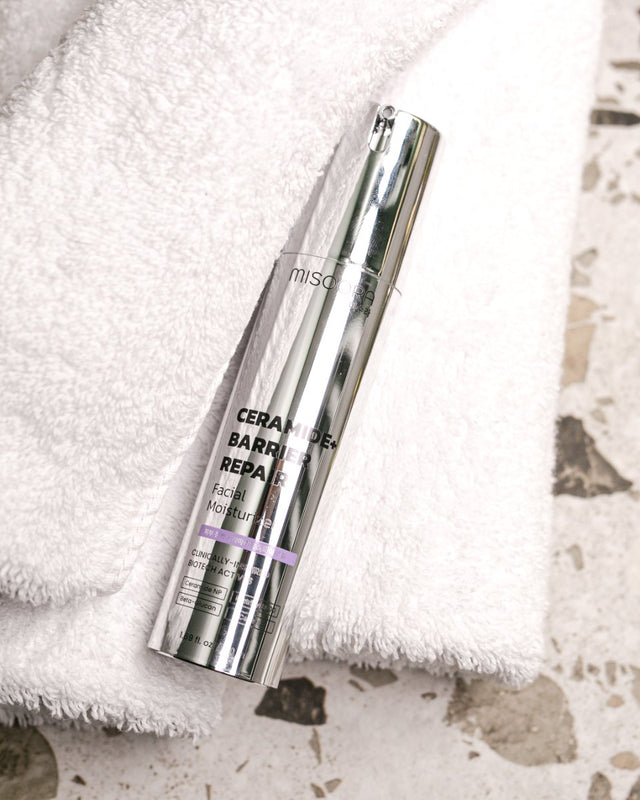
Ceramide+ Barrier Repair Moisturizer
A ceramide-rich cream with no fragrance and no ethanol, made for dry, mature skin. It is the step you will feel first: softer, more comfortable skin from the first night, and a calmer base for your actives.
Shop Ceramide+04What changes between weeks 2 and 12?
Weeks 2 to 6: texture and glow
This is when consistent use starts to show on the surface. As older cells shed and fresher ones reach the top, skin can look smoother and reflect light more evenly. Because that cycle runs past 30 days in older skin,3 one full turn barely fits into this window.
Weeks 6 to 12: the first fair check
Six weeks is the earliest point at which the AAD says most products start to work.2 This is a good moment to compare photos, not before. If you started this week, your six-week check lands just before the holidays and your twelve-week check at the end of January.

How to track it properly
| When | What to do |
|---|---|
| Day 1 | Take a photo in daylight, by the same window, with no makeup. Note what bothers you most: dryness, dullness, lines or uneven tone. |
| Week 2 | Ask how your skin feels. Is it more comfortable? Ignore the mirror for now. |
| Week 6 | Take a second photo in the same spot. Look at texture and glow first. |
| Week 12 | Third photo. This is the fair point to judge tone and fine lines.2 |
| Month 6 | Judge lines and firmness, the slowest changes of all.9 |
05How long does retinol or retinal take to work?
Retinoids are the step with the strongest evidence for fine lines, and also the slowest. Two studies show the timeline well.
- In a 44-week trial of 125 people with sun-damaged skin, 0.05% retinal and 0.05% prescription retinoic acid both produced a significant reduction in wrinkle and roughness measures by week 18. Retinal was well tolerated throughout, while retinoic acid caused more irritation.8
- In a controlled study of naturally aged skin in people with an average age of 87, 0.4% retinol applied up to three times a week reduced fine wrinkles over 24 weeks, and skin biopsies showed more procollagen.9
So give a retinoid at least four to six months before you decide. The first few weeks are about getting your skin used to it. If you start too fast, irritation can make you quit before the good part arrives.

Our pick for the long game
Retinal 0.2% Barrier Serum
Retinal caused significantly less scaling than prescription retinoic acid in a long-term tolerance study,7 and this serum was made for mature, sensitive skin, so it is easier to stay with for the months a retinoid needs. Over time, skin looks smoother and fine lines look softer.
Shop Retinal 0.2%Not sure which retinoid suits you? Our guide to retinal vs retinol vs tretinoin after 50 compares them.
06Can sunscreen change how skin looks?
Yes, and it also runs on months, not days. In a one-year study, 32 women aged 40 to 55 applied a broad-spectrum SPF 30 to the face every morning. Improvements in photoaging measures were significant from week 12 onward, and by the end of the year texture, clarity and blotchy pigmentation had improved by 40% to 52%.10 The study had no comparison group and was funded by a sunscreen maker, so treat the size of the effect with caution. The direction is clear, though: daily protection gives your other products a fair chance.
The AAD recommends broad-spectrum SPF 30 or higher every day for skin in menopause.11
07Why isn't my skincare working?
Usually it is one of these.
“If I don't see a difference in two weeks, it isn't working.”
Two weeks is too early to judge anything but comfort. Most products need at least six weeks, and some need three months.2 Retinoid studies measured wrinkle changes at 18 to 24 weeks.89
“More products will get me there faster.”
The AAD warns that using several anti-aging products at the same time can irritate your skin, and suggests starting with one.2 And the skin barrier recovers more slowly with age.5 Add one new active at a time.
“Once my skin looks better, I can stop.”
People often stop once they see results, the AAD notes, but you need to keep using a product to keep seeing them.2
“My products work, my skin just changed.”
Often true after menopause. More than half of the women in the 2026 survey first mistook menopause-related skin changes for ordinary aging.1 If your old routine was built for younger skin, it may not match what your skin needs now. Dryness and thinning call for barrier care first, then actives.
Skipping sunscreen is the other common reason. Sun protection helps reduce signs of premature aging, the AAD says,2 so daily UV exposure works against what your night routine is trying to build.
08A routine to stick with for 12 weeks

Every morning
- Gentle cleanser.
- NAD+ Firming Serum.
- Ceramide+ moisturizer.
- Broad-spectrum SPF 30 or higher.11
Every evening
- Gentle cleanser.
- Retinal 0.2% on dry skin. New to retinoids? Start two or three nights a week.
- PDRN serum.
- Ceramide+ moisturizer.
Keep the lineup the same for 12 weeks, so you know what is working.

Our pick for nights between checks
PDRN Exosome EGF Night Renewal Serum
2,000 ppm PDRN with exosomes, EGF and a peptide, 2,100 ppm of actives in total. Applied after retinal, it helps skin look bouncier and more rested by morning while you wait for the slower changes.
Shop PDRN Serum


Key takeaways
- Most skincare needs at least six weeks, and up to three months, to show results.2
- After menopause, skin renews more slowly and has less collagen, so expect the longer end.34
- Moisturizer is the fastest win: skin can feel better within hours.6
- Give a retinoid four to six months. Studies measured wrinkle changes at 18 to 24 weeks.89
- Daily SPF 30 or higher protects the progress you make.1011
- Change one thing at a time, take photos at week 6 and week 12, and keep going once it works.2
09FAQ
How long should I try a new serum before I give up on it?
At least six weeks, and up to three months for most products.2 For a retinoid, give it four to six months. Stop sooner only if it irritates your skin.
Is the 28-day skin cycle true after 50?
Not exactly. Renewal of the skin surface took about 20 days in young adults and more than 10 days longer in older adults in one well-known study.3 Think of it as a month or more, and expect changes to take a few cycles.
Why does my skin look worse when I start retinal?
Mild dryness or flaking in the first weeks is common with retinoids. Retinal tends to be gentler than prescription retinoic acid.78 Use it two or three nights a week, follow with moisturizer, and build up slowly. If your skin burns or stays red, stop and talk to a dermatologist.
Can I speed up results?
Not by piling on products, which can irritate skin.2 What helps is consistency: the same routine morning and night, daily sunscreen, and moisturizer on slightly damp skin.1112
Does hormone therapy change how fast skincare works?
Hormone therapy is a medical decision with its own benefits and risks, so it is one to discuss with your doctor rather than make for your skin alone. For what topical options can and can't do, see our guide to estrogen face cream.
When should I see a dermatologist instead?
If a spot changes, bleeds or won't heal, if you have a rash that doesn't settle, or if three months of a steady routine bring no change at all, it is worth a visit.
Keep reading: Menopause skin care: what changes and what helps · Retinal vs retinol vs tretinoin after 50
References
- Galderma. New Galderma research reveals more than half of women mistake menopause-related skin changes for signs of ageing. Press release, October 13, 2026. Survey by Perspectus Global, 5,090 women, August–September 2026.
- American Academy of Dermatology. How to maximize results from anti-aging skin care products.
- Grove GL, Kligman AM. Age-associated changes in human epidermal cell renewal. Journal of Gerontology. 1983;38(2):137–142.
- Calleja-Agius J, Muscat-Baron Y, Brincat MP. Skin ageing. Menopause International. 2007;13(2):60–64.
- Ghadially R, Brown BE, Sequeira-Martin SM, Feingold KR, Elias PM. The aged epidermal permeability barrier. Journal of Clinical Investigation. 1995;95(5):2281–2290.
- Spada F, Barnes TM, Greive KA. Skin hydration is significantly increased by a cream formulated to mimic the skin's own natural moisturizing systems. Clinical, Cosmetic and Investigational Dermatology. 2018;11:491–497.
- Fluhr JW, Vienne MP, Lauze C, Dupuy P, Gehring W, Gloor M. Tolerance profile of retinol, retinaldehyde and retinoic acid under maximized and long-term clinical conditions. Dermatology. 1999;199(Suppl 1):57–60.
- Creidi P, Vienne MP, Ochonisky S, et al. Profilometric evaluation of photodamage after topical retinaldehyde and retinoic acid treatment. Journal of the American Academy of Dermatology. 1998;39(6):960–965.
- Kafi R, Kwak HS, Schumacher WE, et al. Improvement of naturally aged skin with vitamin A (retinol). Archives of Dermatology. 2007;143(5):606–612.
- Randhawa M, Wang S, Leyden JJ, et al. Daily use of a facial broad spectrum sunscreen over one-year significantly improves clinical evaluation of photoaging. Dermatologic Surgery. 2016;42(12):1354–1361.
- American Academy of Dermatology. Skin care during menopause.
- American Academy of Dermatology. How to pick the right moisturizer for your skin.
Written by MISOORA Editorial. This article is for general information and is not medical advice. Talk to your doctor or a dermatologist about any skin change that worries you. Product results are cosmetic and vary from person to person.