

Mature Skin · Guide
If your face looks flat, gray or tired even after a full night's sleep, you are not imagining it. Here is why skin loses its glow around menopause, why fall and winter make it worse, and the routine that brings back a brighter, healthier look.

The short answer
Skin looks dull after menopause because the surface renews more slowly, holds less water and oil, and gets thinner as collagen drops. Dead cells pile up and scatter light instead of reflecting it, so the face reads as flat or gray.345 What helps: a gentle cleanser, a retinoid at night to keep renewal moving, a moisturizer that rebuilds the barrier, daily SPF 30+, and sleep. Harsh scrubs usually make it worse.
01What does dull skin actually mean?
Dermatologists describe radiance as the skin's ability to reflect light. It depends on how smooth and well hydrated the surface is, and on whether dry, dead cells are sitting on top and blocking that reflection. Dullness, or sallowness, is the absence of that glow, sometimes with a yellowish undertone.3
In other words, dull skin is mostly an optical problem. Light that hits a smooth, plump surface bounces back evenly and the face looks fresh. Light that hits a rough, flaky surface scatters in every direction and the face looks flat, even if nothing else has changed.
Illustration: MISOORA Editorial, based on the skin quality definitions in Humphrey et al., 2021.3
of peri- and postmenopausal women aged 45 to 60 reported a duller facial skin tone in a nine-country survey of more than 4,300 women, presented in 2026.1
02Why does skin look dull after menopause?
There is rarely one cause. Five changes tend to arrive together in your late 40s and 50s, and each one takes a little light out of the complexion.
1. The surface renews more slowly
In a classic study of skin renewal, the outer layer of skin (the stratum corneum) replaced itself in about 20 days in younger adults. In older adults it took more than 10 days longer, and the slowdown was sharpest after age 50.4 More days on the surface means more dry, dead cells stacked up where light needs to bounce.
2. Estrogen loss leaves skin drier and thinner
Estrogen helps skin hold water and keeps it thick and well supplied with collagen. When levels fall, skin becomes thinner, drier and less elastic.5 Sebum, the skin's own oil that gives a natural sheen, also drops after menopause.6 Dry skin is rough skin, and rough skin looks matte.
3. Less color from below
Part of a healthy glow comes from the pink of small blood vessels showing through. In a study of women aged 20 to 74, the density of capillary loops near the surface was 40 to 70% lower in the oldest group than in the youngest.7 Combined with thinner skin, that can leave the complexion looking paler or more sallow.
03Is it menopause or just aging?
Both, and the overlap confuses a lot of women. In a survey of more than 5,000 women released by Galderma this October, 56% said they first blamed their menopause-related skin changes on aging, and half did not know that hormonal shifts in perimenopause and menopause can affect the skin at all.2
That matters for what you buy. A generic anti-aging cream aimed at fine lines may do little for dullness if your real issue is a dry, slow-shedding surface. The fix is a routine that keeps renewal moving and repairs the barrier at the same time, without the harshness that mature skin no longer tolerates.

Why it builds up
Dull skin is usually several small problems stacked together: a slower surface, less moisture, thinner skin and a weaker barrier. That is why one product rarely fixes it, and why a full routine works better than a single strong exfoliant.
Think of it in two jobs. In the morning, cleanse gently, hydrate and protect. At night, encourage renewal and let skin recover.
04Why does dullness get worse in fall and winter?
Many women notice their skin looks its grayest between November and March. Cold air outside and dry heated air inside pull water from skin that is already drier after menopause. Hot showers and stronger cleansers strip more oil. Shorter days and the clock change can also cut into sleep, and sleep shows on the face: in a study published in the BMJ, observers rated photos of people after sleep deprivation as looking less healthy and more tired than photos of the same people after normal sleep.12

What actually helps in cold months
- Wash with a mild cleanser instead of soap, which can be too drying for mature skin.8
- Keep showers short and warm, not hot, and moisturize while skin is still slightly damp.
- Reapply moisturizer whenever skin feels tight.8
- Keep wearing broad-spectrum SPF 30 or higher every day, even in winter.8

Our pick for gentle cleansing
Centella Ceramide Amino Acid Cleanser
A sulfate-free, pH-balanced cleanser with centella and ceramides that lifts away makeup and SPF without the tight, squeaky feeling that makes dull skin look duller.
Shop the cleanser05Should you exfoliate mature skin?
Exfoliating removes the dead cells that scatter light, so it is the obvious move. After menopause, though, it needs a lighter hand. The American Academy of Dermatology notes that skin gets thinner in menopause and that at-home exfoliation or microdermabrasion can harm it, so it suggests checking with a dermatologist before you start.8
The AAD also warns that exfoliating on top of retinol or prescription retinoids can increase dryness and peeling, and that the more aggressive the method, the less often you should use it.9
| Approach | For dull, mature skin |
|---|---|
| Grainy scrubs, daily brushes | Usually too rough. They can leave thin skin red and irritated, which looks worse, not brighter. |
| Strong acid peels at home | Risky if you also use a retinoid. Ask a dermatologist first. |
| A retinoid at night | Encourages renewal from within, so you need far less scrubbing on top. |
| Washcloth plus a mild cleanser | The AAD's suggestion for dry or sensitive skin. Gentle, low risk, easy to keep up.9 |
06Which ingredients bring back glow?
Retinoids: keep the surface moving
Retinoids are among the best-studied ingredients for aging skin, and the AAD notes that a retinoid cream can help some women in menopause.8 Retinal (retinaldehyde) is the form one step away from retinoic acid. In an 18-week trial of 125 people with sun-damaged facial skin, a 0.05% retinal cream reduced measured wrinkles and surface roughness and was well tolerated, while prescription retinoic acid caused more irritation.10 Smoother texture means more even light reflection.

Our pick for rough, dull texture
Retinal 0.2% Barrier Serum
Retinaldehyde at 0.2%, buffered with a full barrier complex so mature, sensitive skin can use it night after night for smoother-looking, brighter texture.
Shop Retinal 0.2%NAD+: support for tired-looking skin
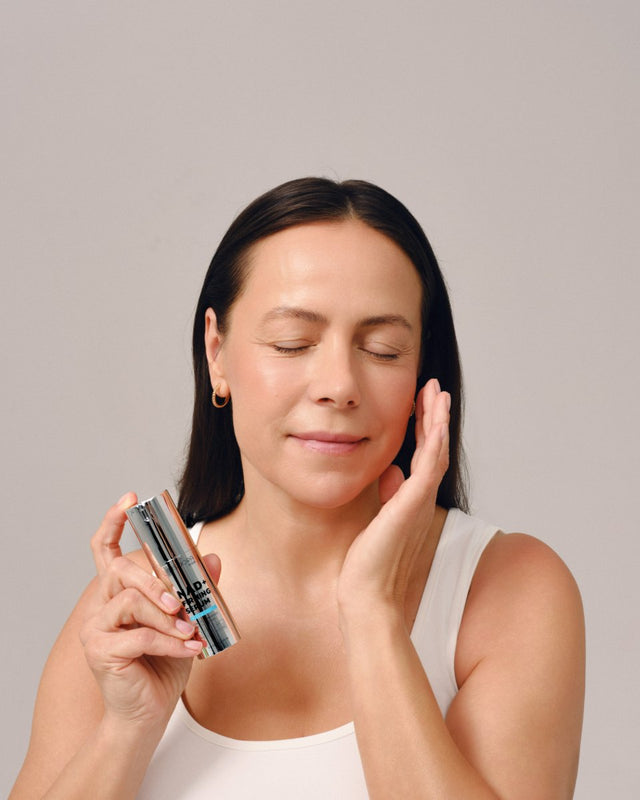
NAD+ is a molecule cells use to make energy and repair themselves. Lab analysis of human skin samples found that NAD+ levels decline with age.11 A topical NAD+ serum will not reverse that, but it is a good morning step for skin that looks tired and flat.

Our pick for a rested morning look
NAD+ Firming Serum
2,500 ppm NAD+ with peptides for visibly firmer, smoother-looking skin with more radiance. Light enough to wear under SPF and makeup.
Shop NAD+ SerumCeramides and humectants: fix the dry surface
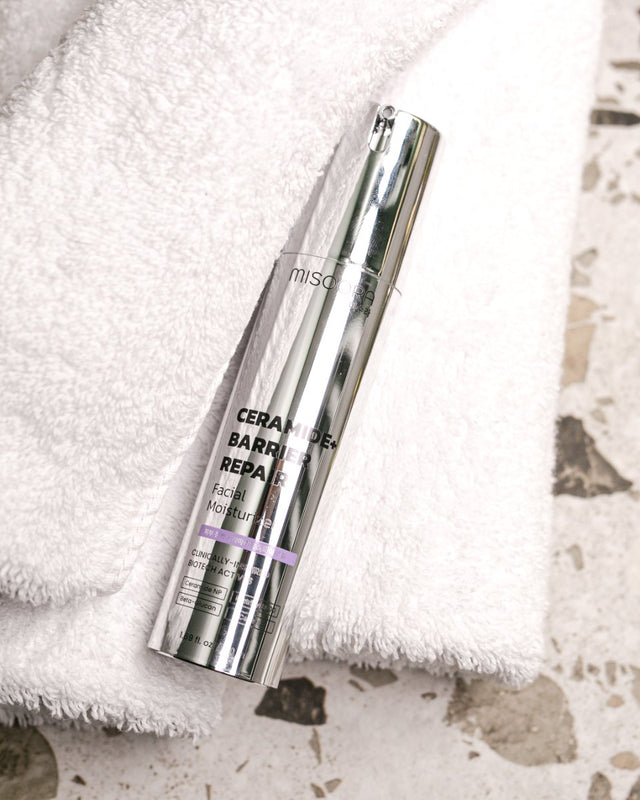
Because dryness is one of the main reasons mature skin looks matte, moisturizer is not optional. The AAD points to hyaluronic acid and glycerin as helpful for menopausal skin.8 Ceramides help rebuild the lipid barrier, so water stays in and the surface stays smooth.
Sunscreen: protect what you build
Daily broad-spectrum SPF 30 or higher on the face, neck and hands, all year, is the AAD's baseline for menopausal skin.8 Unprotected UV keeps adding roughness and uneven tone, which undoes the rest of your routine.
07A glow routine for dull skin after 50
Keep it short and consistent. Results come from doing a few gentle things every day, not from one dramatic treatment.
Morning
Cleanse, energize, protect

Evening
Renew and recover

The evening order matters: retinal first, then the PDRN serum, then moisturizer. Our PDRN Exosome EGF Serum pairs 2,000 ppm PDRN with exosomes, EGF and a peptide (2,100 ppm of actives in total) to help skin look smoother, denser and more even with consistent use. If you are new to retinoids, begin with a few nights a week and build up as your skin allows.


08How to look brighter before an event
Holiday parties are coming. If you need a fresher look by the weekend, skip anything new or harsh and focus on the surface:
- Hydrate the night beforeApply your serum, then a generous layer of moisturizer, so skin wakes up smoother.
- Skip the scrubA new exfoliant right before an event is the fastest way to end up red or flaky.
- Layer thin, not thickMoisturizer first, then a light, dewy base. Heavy matte powder sits in dry patches and looks flat.
- Protect your sleepTired faces read as less healthy to other people, so an early night is worth more than a new product.12
09When to talk to a doctor
Ordinary dullness builds slowly and improves with a better routine. Talk to your doctor if your skin tone changes suddenly, if your skin or the whites of your eyes look yellow, or if dullness comes with fatigue, weight change or other new symptoms. A dermatologist can also suggest in-office options if you want faster results, and can tell you whether exfoliation is safe for your skin.8
Key takeaways
- Dull skin is mostly about light: a dry, rough, slow-shedding surface scatters it instead of reflecting it.
- After menopause, surface renewal slows, skin gets drier and thinner, and collagen drops by about 30% in the first five years.
- Fall and winter add dry air, hot showers and shorter sleep, so dullness often peaks now.
- Gentle beats harsh: a mild cleanser, a retinoid at night, a ceramide moisturizer and daily SPF 30+.
- Keep the evening order simple: retinal, then PDRN serum, then moisturizer.
FAQ
Why does my skin look gray after menopause?
Mostly because the surface sheds more slowly and holds less water and oil, so dry cells build up and scatter light. Thinner skin and fewer small blood vessels near the surface can also make the complexion look paler.
Can dull skin be reversed?
Skin often looks smoother and brighter soon after you switch to gentle cleansing and steady moisturizing, because a hydrated surface reflects more light. Retinoids work more slowly: in the retinal study above, texture changes were measured at 18 weeks.
Is vitamin C or a retinoid better for dull skin after 50?
They do different jobs. A retinoid at night encourages renewal and smoother texture, which is the main issue in dull mature skin. A practical split is a retinoid at night and an antioxidant or energizing serum in the morning.
How often should I exfoliate mature skin?
Less than you think. If you use a retinoid, you may not need extra exfoliation at all. The AAD advises asking a dermatologist before exfoliating thinner menopausal skin.
Does hormone therapy help dull skin?
Estrogen affects skin thickness and hydration, so some women notice changes on hormone therapy, but it is not prescribed for skin alone. That is a decision to make with your doctor based on your overall health.
Keep reading
- Why Is My Skin So Dry After Menopause? A Winter Plan for Dry, Tight, Itchy Skin
- Retinal vs Retinol vs Tretinoin After 50: Which Retinoid Suits Mature, Sensitive Skin
References
- Galderma survey of 4,300+ peri- and postmenopausal women aged 45 to 60 in nine countries, presented at IMCAS World Congress 2026. Reported in: Survey reveals knowledge gap in menopause-related skin changes. Plastic Surgery Practice, February 2026. plasticsurgerypractice.com
- Galderma. New Galderma research reveals more than half of women mistake menopause-related skin changes for signs of ageing. Business Wire, October 13, 2026 (survey of 5,090 women in the US, UK, Brazil and China; data on file). uniindia.com
- Humphrey S, Manson Brown S, Cross SJ, Mehta R. Defining skin quality: clinical relevance, terminology, and assessment. Dermatol Surg. 2021;47(7):974-981. PMC8231670
- Grove GL, Kligman AM. Age-associated changes in human epidermal cell renewal. J Gerontol. 1983;38(2):137-142. PubMed 6827031
- Thornton MJ. Estrogens and aging skin. Dermatoendocrinol. 2013;5(2):264-270. PubMed 24194966
- Russell-Goldman E, Murphy GF. The pathobiology of skin aging: new insights into an old dilemma. Am J Pathol. 2020;190(7):1356-1369. PMC7481755
- Li L, et al. Age-related changes of the cutaneous microcirculation in vivo. Gerontology. 2006;52(3):142-153. PubMed 16645294
- American Academy of Dermatology. Skin care during menopause. aad.org
- American Academy of Dermatology. How to safely exfoliate at home. aad.org
- Creidi P, et al. Profilometric evaluation of photodamage after topical retinaldehyde and retinoic acid treatment. J Am Acad Dermatol. 1998;39(6):960-965. PubMed 9843009
- Massudi H, Grant R, Braidy N, Guest J, Farnsworth B, Guillemin GJ. Age-associated changes in oxidative stress and NAD+ metabolism in human tissue. PLoS One. 2012;7(7):e42357. PubMed 22848760
- Axelsson J, et al. Beauty sleep: experimental study on the perceived health and attractiveness of sleep deprived people. BMJ. 2010;341:c6614. bmj.com
Written by MISOORA Editorial. This article is for general information and is not medical advice. Skincare results described are cosmetic and vary from person to person. If you have concerns about changes in your skin, talk to your doctor or a board-certified dermatologist.