

Menopause & Mature Skin · Cleansing Guide
Your skin feels tight and dry minutes after washing, sometimes even stings. Nothing about your cleanser changed, but your skin did. Here is what that feeling means after menopause, and how to wash your face without stripping it.

The short answer
A tight face after washing means the cleanse took more than dirt. Soap and harsh detergents are alkaline (most bar soaps sit at pH 9 to 10, while skin sits below 5),23 hot water makes detergent irritation worse,4 and after menopause the barrier has fewer lipids to lose and repairs more slowly.678 The fix is simple: a mild, non-soap cleanser, lukewarm water, fingertips instead of cloths, a gentle pat dry, and moisturizer while skin is still damp.91011
01Why does my face feel tight after washing?
That squeaky, pulled feeling is not a sign of a deep clean. It is a sign the wash removed some of what keeps skin comfortable: the oils on the surface and part of the lipid layer that holds water in.
Two things drive it. The first is the cleanser itself. Detergents such as sodium lauryl sulfate (SLS) lift oil very efficiently, which is why researchers use SLS to irritate skin on purpose in lab studies. Residue left after rinsing raises water loss through the skin and causes irritation.5
The second is pH. The skin surface is naturally acidic, around pH 4.7 on average.2 That acidity suits the skin's own resident microbes. Most bar soaps sit far from it: in one test of 64 soaps, 53 measured between pH 9 and 10.3 Even plain tap water nudges skin toward alkaline.
How long tap water alone can keep skin's surface pH raised after washing, according to researchers who measured skin pH in 330 adults.2 Wash twice a day and that window opens twice.
02Why is it worse after menopause?
If the same cleanser felt fine at 40, it is not your imagination. After menopause, skin loses some of its ability to hold water and can get quite dry, especially in dry air.10 Three changes make each wash land harder:
- The lipid mix shifts. Menopause changes the ceramide profile of the skin's outer layer, the lipids that seal moisture in. In the same study, women on hormone therapy did not show the shift.6
- Less oil on the surface. Oil glands slow down, so there is less natural sebum to cushion the skin against detergents.7
- Slower repair. Aged skin rebuilds its barrier more slowly after it is disrupted, so a stripping wash takes longer to recover from.8
Then there is the season: indoor heating dries the air,12 and the stretch between washing and moisturizing becomes the moment your face feels it most. The good news is that cleansing is the easiest step in a routine to fix.
03Is hot water bad for your face?
For a face that already feels tight, yes. In a controlled study, the same detergent was applied to skin at three temperatures for four days. Irritation, water loss and redness rose with the water temperature, and the warmest solution did the most damage.4
Dermatologists recommend lukewarm water for the face, and short, warm (not hot) showers for dry skin.911 A practical test: if the water would feel too warm on the inside of your wrist, it is too warm for your face. If you like a hot shower, wash your face at the sink afterward instead of under the spray.
04What is the best cleanser for mature skin?
The American Academy of Dermatology is direct about it: for mature skin, soap can be too drying, so wash with a mild cleanser instead, and skip deodorant bars.10 Look for a gentle, non-abrasive formula without alcohol,9 and choose products labeled fragrance-free rather than unscented.11
| On the label | Why it matters after 50 |
|---|---|
| Non-soap, sulfate-free | Milder detergents remove makeup and sunscreen without the high pH of soap or the bite of SLS. |
| pH-balanced | Closer to skin's own slightly acidic surface, so the barrier has less to recover from. |
| Fragrance-free | Dermatologists advise avoiding fragrance on dry skin; mature skin reacts more easily.11 |
| No scrub beads | Skin thins after menopause; at-home scrubbing can do more harm than good.10 |
| Barrier lipids (ceramides) | A cleanser cannot repair the barrier, but it can avoid taking more away. |

Our pick for tight, dry skin after washing
Centella Ceramide Amino Acid Cleanser
A sulfate-free, pH-balanced amino acid cleanser with centella and ceramides. It lifts away makeup, SPF and oil and leaves skin soft, not squeaky. Fragrance-free, for morning and evening.
Shop the cleanser05Should you wash your face in the morning?

Dermatologists suggest washing no more than twice a day, morning and night, plus after heavy sweating.9
In the morning your face only needs to lose a night's worth of sweat, oil and leftover night cream, so the wash can be quick: a small amount of a gentle cleanser, fingertips, lukewarm water, done in under a minute.
If your skin is very dry, you can try a splash of lukewarm water in the morning and save the cleanser for night, as long as your skin stays comfortable and clear. At night, always cleanse: sunscreen, makeup and the day's grime need to come off before your serums go on.
06Do you need to double cleanse?
Only some nights. Double cleansing means an oil or balm first to melt makeup and sunscreen, then a gentle cleanser to rinse it all away. It is useful after long-wear foundation, waterproof mascara or a water-resistant sunscreen.
On a no-makeup day, one gentle wash is enough. Two full washes with a foaming cleanser, every night, is a common reason mature skin ends up tight. If you do double cleanse, keep both steps short and the water lukewarm.
What actually helps
- Use fingertips, not a washcloth or mesh sponge; both can irritate.9
- Massage gently in small circles, then rinse well with lukewarm water.
- Do not scrub. Scrubbing irritates skin, and it does not clean better.9
- Be extra gentle around the eyes.9
07Can hard water make it worse?
It can. In a study of 80 people, washing with hard water left more detergent residue on the skin than soft water. That residue raised water loss and irritation, and the effect was strongest in people with eczema-prone skin. Softening the water reduced the harm.5
You do not need to install a softener to benefit. A detergent-light, non-soap cleanser leaves less to deposit in the first place, and a thorough lukewarm rinse helps remove what is left. If you notice white spots on your faucet and tight skin after every wash, hard water may be part of the story.
08What to do in the minute after washing

The minute after you rinse matters more than most people think. Pat dry with a soft, clean towel instead of rubbing.911 Then moisturize while skin is still slightly damp, which helps trap the water that is already there.11
A cream does more than a lotion for dry skin,11 and a fragrance-free formula is the safer choice when skin feels irritated.10 Look for barrier lipids such as ceramides, plus humectants like glycerin or hyaluronic acid.10

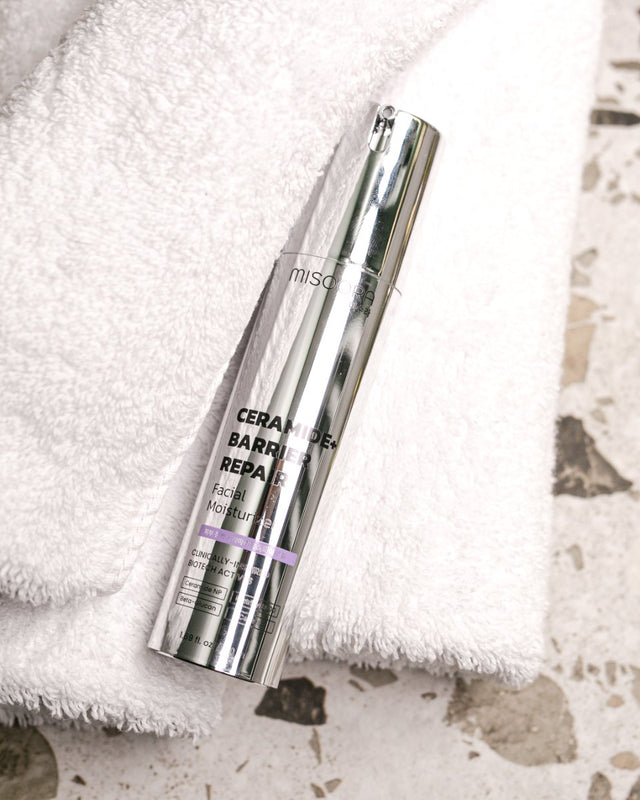
Our pick for the step after cleansing
Ceramide+ Barrier Repair Moisturizer
A ceramide-rich, fragrance-free cream that relieves tightness from the first use and seals in your serums, morning and night.
Shop the moisturizerMorning
Quick and gentle, under a minute at the sink

Evening
Cleanse once, or twice if you wore heavy makeup


Every step in both routines starts with the same cleanser, which is why it is worth getting right. The sets below bundle the steps in the order they work best.


09When to see a dermatologist
Tightness that fades once you moisturize is a routine problem. See a board-certified dermatologist if dryness continues despite a gentle routine, since conditions such as eczema or psoriasis can be the cause,11 or if you notice:
- Stinging or burning with even mild, fragrance-free products
- Red, scaly patches, cracking or itching that keeps you up at night
- Sudden flushing, bumps or breakouts that are new for you
More than half of women in a recent international survey mistook menopause-related skin changes for ordinary aging,1 so it is worth mentioning skin changes at your next menopause appointment too.
Key takeaways
- A tight, squeaky face after washing is a sign of a stripped barrier, not a deep clean.
- Skin sits below pH 5; most bar soaps sit at 9 to 10. After menopause, choose a mild, non-soap, fragrance-free cleanser.
- Use lukewarm water. Hotter water made the same detergent more irritating.
- Wash no more than twice a day, with fingertips, and do not scrub.
- Pat dry and moisturize while skin is still damp, with a ceramide cream.
- Double cleanse only on heavy-makeup or water-resistant-sunscreen days.
FAQFrequently asked questions
Is it bad if my face feels squeaky clean?
For mature skin, usually yes. That feeling means oils and some barrier lipids were washed away along with the dirt. A gentle cleanser should leave skin feeling soft and comfortable, not tight.
Can I wash my face with just water?
In the morning, a lukewarm water rinse can be enough for very dry skin. At night you need a cleanser to remove sunscreen and makeup, because water alone does not lift them well.
Why does my skin sting when I apply serum after washing?
Stinging right after cleansing often means the cleanser was too harsh or the water too hot, leaving the barrier briefly more open. Switch to a mild cleanser and lukewarm water, and apply retinoids on fully dry skin.
Can I use my body wash or bar soap on my face?
It is better not to after menopause. Dermatologists note that soap can be too drying for mature skin and suggest a mild cleanser instead.10 Most bar soaps are also strongly alkaline.3
Is a pH-balanced cleanser really better?
Skin's surface is naturally acidic, around pH 4.7, and alkaline products push it up.2 A pH-balanced cleanser stays closer to skin's own range, which makes it a gentler daily choice for dry, mature skin.
How often should I wash my face after 50?
Twice a day at most, morning and night, and after heavy sweating.9 If your skin feels tight, try cleanser at night only and a water rinse in the morning.
Keep reading: Why is my skin so dry after menopause? A winter plan · Hyaluronic acid or ceramides after menopause?
References
- Galderma. New Galderma research reveals more than half of women mistake menopause-related skin changes for signs of ageing. Press release (Business Wire), October 13, 2026.
- Lambers H, Piessens S, Bloem A, Pronk H, Finkel P. Natural skin surface pH is on average below 5, which is beneficial for its resident flora. International Journal of Cosmetic Science. 2006;28(5):359–370.
- Tarun J, Susan J, Suria J, Susan VJ, Criton S. Evaluation of pH of bathing soaps and shampoos for skin and hair care. Indian Journal of Dermatology. 2014;59(5):442–444.
- Berardesca E, Vignoli GP, Distante F, Brizzi P, Rabbiosi G. Effects of water temperature on surfactant-induced skin irritation. Contact Dermatitis. 1995;32(2):83–87.
- Danby SG, Brown K, Wigley AM, et al. The effect of water hardness on surfactant deposition after washing and subsequent skin irritation in atopic dermatitis patients and healthy control subjects. Journal of Investigative Dermatology. 2018;138(1):68–77.
- Kendall AC, Pilkington SM, Wray JR, et al. Menopause induces changes to the stratum corneum ceramide profile, which are prevented by hormone replacement therapy. Scientific Reports. 2022;12:21715.
- Pagac MP, Stalder M, Campiche R. Menopause and facial skin microbiomes: a pilot study revealing novel insights into their relationship. Frontiers in Aging. 2024;5:1353082.
- Ghadially R, Brown BE, Sequeira-Martin SM, Feingold KR, Elias PM. The aged epidermal permeability barrier: structural, functional, and lipid biochemical abnormalities in humans and a senescent murine model. Journal of Clinical Investigation. 1995;95(5):2281–2290.
- American Academy of Dermatology. Face washing 101.
- American Academy of Dermatology. Skin care during menopause.
- American Academy of Dermatology. Dermatologists’ top tips for relieving dry skin.
- American Academy of Dermatology. Cold weather and your skin.
Written by MISOORA Editorial. This article is for general information and is not medical advice. Product results are cosmetic and vary from person to person.